
Grundy County Court Records Path
After a Grundy County arrest, the first record may be a jail or law-enforcement record held by the Grundy County Sheriff's Office. If the person is booked into the Grundy County Jail, custody questions still go through the jail information line or Sheriff's Records Division because no official public current-inmate roster was found in the county research. That booking event does not by itself prove what charge will move forward in court.
The court record begins when the State prosecutes the case in Grundy County Circuit Court. The Circuit Clerk Criminal and Traffic Division describes criminal cases as cases prosecuted by the State, including misdemeanors, felonies, ordinance violations, DUI matters, and juvenile matters. For booking custody details, use Grundy County jail inmate records. For booking photos and mugshot access limits, use Grundy County jail mugshots.
Record split: Sheriff records document the arrest, booking, custody receipt, and jail status. Circuit Clerk records document filed charges, hearings, orders, dispositions, and certified court copies.
Find Grundy Court Records
The Grundy County Circuit Clerk and the 13th Judicial Circuit both route public case lookup to Judici for Grundy County. The court search is the practical first stop after a jail arrest because a no-roster result at the jail does not mean no case exists. Court filing may lag behind booking, and early police allegations can change once the prosecutor reviews reports, witness statements, lab results, and release or detention issues.
- Open the official Judici Grundy County case search from the Circuit Clerk or 13th Judicial Circuit link.
- Search by the fields Judici displays, such as party name or case number if available.
- Open the matching case and review the filed charge list, court dates, docket entries, and current status.
- Use the Circuit Clerk copy process when a filed complaint, disposition, certified docket entry, or mailed copy is needed.
The 13th Judicial Circuit search page is another official route into the same case-search path. Public pages may show a CAPTCHA, so exact fields can vary at the moment of access. If the case cannot be located by name, the Circuit Clerk can help with copy and case questions, while the Sheriff's Records Division handles law-enforcement and arrest-record requests.
The manifest screenshot from Judici's Grundy County case search shows the official court lookup entry point used for public court records after a jail arrest.
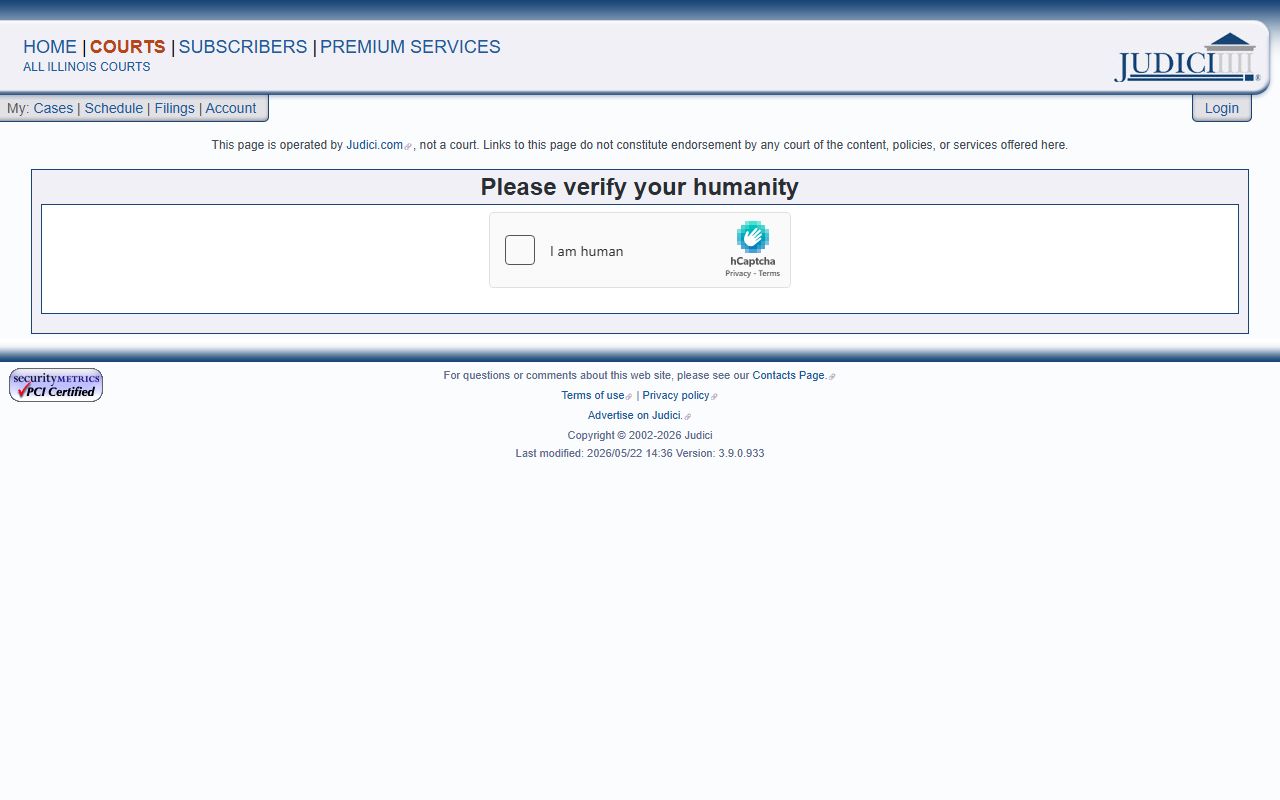
Use the county or circuit link when possible, since that confirms the lookup is the official court-search channel rather than an unrelated background-check site.
Grundy Court Search Fields
Full live inspection of the Judici form was blocked by a CAPTCHA during the research pass. The safe, source-backed statement is that the Grundy County Judici link is official and that users should search by the fields Judici displays at access time. Case number and party-name search are common Judici paths, but field labels should be read from the live form before a person relies on them.
| Field Label | Type | Required | Notes |
|---|---|---|---|
| Judici fields not fully captured | Web case-search form | Unspecified | Public page may require CAPTCHA; use the county or 13th Circuit link for the official route. |
| Party name, if displayed | Text search | Varies | Useful when the case number is unknown after a Grundy County jail arrest. |
| Case number, if displayed | Text search | Varies | Best for narrowing copies, docket entries, and certified disposition requests. |
Grundy Court Copy Requests
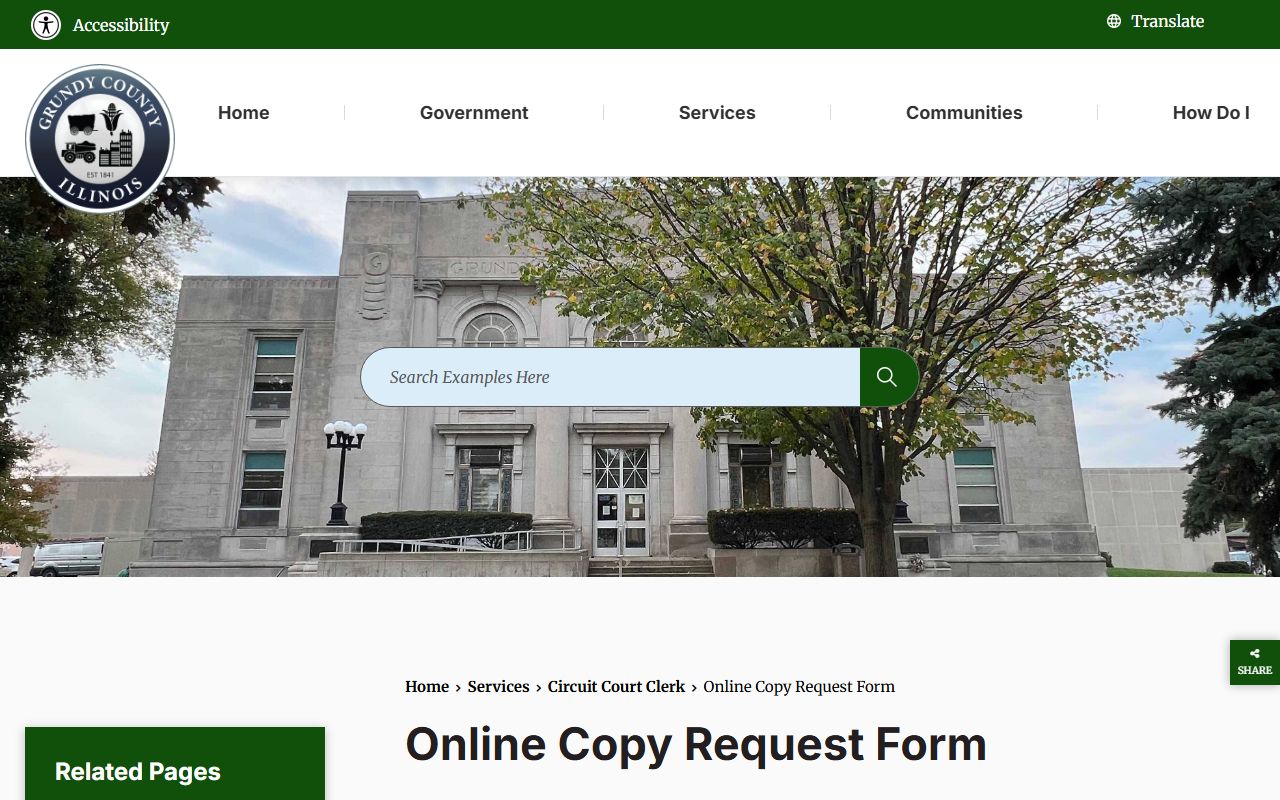
The Circuit Clerk online copy request form is the county's concrete route for court records after an arrest when a public case-search screen is not enough. The form asks for requester identity and contact details, then asks for the case number if known, names on the record, documents requested, and added information. It also allows non-certified copies by email and certified copies or mailed copies when needed.
| Copy Request Field | How It Helps |
|---|---|
| Name on record | Connects the request to the defendant or party tied to the criminal case. |
| Date of birth | Optional criminal-case identifier that helps separate people with similar names. |
| Case number | Speeds retrieval when Judici or a notice provides the court file number. |
| Documents requested | Use for complaints, informations, indictments, orders, docket sheets, or dispositions. |
| Certification and delivery | Specifies whether copies should be certified, emailed, or mailed. |
Copy fees are published by the Circuit Clerk: page one is $2.00, pages two through nineteen are $0.50 each, and pages twenty and over are $0.25 each. Certification charges and postage may apply under the Clerk's Act. Criminal case copy questions go to 815-941-3260, while the main Circuit Clerk office lists 815-941-3256 and circuitclerk@grundycountyil.gov.
The Circuit Clerk copy request form screenshot shows the requester, case, document, certification, and mailing fields used for Grundy County court records.
That form is separate from a Sheriff's FOIA request. Clerk copies are court records; Sheriff's FOIA requests are used for law-enforcement, jail, and arrest records.
Grundy Charging Documents
Charges can begin in different forms after a Grundy County arrest. A complaint may start a case based on an officer or prosecutor's sworn allegation. An information is filed by the prosecutor and is often used in felony practice without a grand-jury indictment. An indictment comes from a grand jury and is usually tied to serious felony prosecution. The filed document matters because it is the court record that tells the reader what the State chose to pursue, not just what appeared at booking.
| Document | Filed By | Common Use | What to Request |
|---|---|---|---|
| Complaint | Officer or prosecutor | Initial misdemeanor or felony filing | Complaint and any amended complaint |
| Information | State's Attorney | Many felony prosecutions | Information, amendments, and related orders |
| Indictment | Grand jury | Serious felony prosecution | Indictment and docket entries showing later action |
The Grundy County State's Attorney prosecutes criminal cases and works with agencies such as the Grundy County Sheriff's Department, Illinois State Police, Morris Police Department, Minooka Police Department, Coal City Police Department, Channahon Police Department, and other local agencies named in the research. That is why a police arrest from a city or state agency can still become a Grundy County Circuit Court case.
Grundy Charge Status Records
Charge status can change several times after arrest. A booking charge may be preliminary. The State's Attorney may file a different count, amend the language, reduce the level, add a related count, or dismiss a count. A court record after a jail arrest should be read by status and by date, not just by the first charge name that appears.
| Status | Plain Meaning | Record Tip |
|---|---|---|
| Pending | The filed charge is still active. | Check the next court date and any pretrial release or detention order. |
| Amended | The State changed the charge wording, count, or citation. | Request the amended charging document, not only the first filing. |
| Reduced | The charge level or offense was lowered. | Compare the amended charge to the original complaint or information. |
| Dismissed | The court record shows that count is no longer being pursued. | Review whether other counts in the same case remain active. |
| Disposition entered | The case or count has a result, such as a plea, finding, or dismissal. | Certified dispositions are requested from the Circuit Clerk. |
A dismissed charge is not the same thing as an erased record. Public access can still depend on sealing, expungement, juvenile-record rules, and statutory exemptions. When the public screen is unclear, a certified disposition from the Circuit Clerk is usually the cleaner record for jobs, licenses, housing files, or attorney review.
Release After Grundy Arrest
Illinois no longer uses cash bail as a condition of pretrial release. Since September 18, 2023, release or detention after a new Grundy County arrest is handled under the Pretrial Fairness Act and SAFE-T Act framework. People still use the words bond and bail when searching, and older court entries may still show bond language, but current release decisions are made through court-ordered release conditions or detention.
| Term | Current Meaning |
|---|---|
| Pretrial release | The court allows release while the case is pending, with conditions if ordered. |
| Detention | The court orders the person held while the case is pending under Illinois pretrial law. |
| Hold or detainer | Another agency or case may prevent release even if the local case changes status. |
| Historical bond | Older records or old obligations may still use bond wording, but that is not the current release model for new arrests. |
For a recent Grundy County jail arrest, check the Judici court file and call the jail for custody status rather than relying on a bond-company lookup. The county research did not find a Grundy-specific public page for posting cash bail, and the build should not create one by assumption.
Grundy Warrants and Court Records
No official Grundy County sheriff active-warrant search page was found in the research. A warrant can still appear in the court case record, especially when the warrant is tied to failure to appear, a bench warrant, or a new criminal case. Judici and the Circuit Clerk are the court-side routes, while the Sheriff's Office handles law-enforcement questions and custody contact.
For official contacts, the Sheriff's page lists Crime Stoppers at 815-942-9667 and emergency access through 911. For a person already in custody, the jail information line is 815-941-3243. For copies or docket entries, use the Circuit Clerk. Do not rely on commercial warrant or mugshot pages when an official court or sheriff source is available.
Charges Versus Convictions
A charge is an allegation filed in court. A conviction is a result based on a guilty plea, finding, or verdict. Court records after a jail arrest often show both the accusation and the later outcome, so the status column and disposition date matter. A person can be arrested and charged without being convicted.
| Point | Charge | Conviction |
|---|---|---|
| Stage | Filed accusation after arrest review | Final or count-specific case outcome |
| Proof | Based on probable cause or charging review | Based on plea, finding, or verdict |
| Record use | Shows what the State alleged | Shows what was legally resolved against the person |
| Best copy | Charging document and docket sheet | Certified disposition from the Circuit Clerk |
Sealed and Expunged Records
Public access to court records after an arrest can narrow when a record is sealed, expunged, juvenile, tied to an active investigation, or protected by another Illinois exemption. Illinois FOIA supports access to non-exempt records, and Section 2.15 covers arrest information, but it does not override every privacy, juvenile, medical, witness, or sealing rule.
| Record State | Public Access | Practical Effect |
|---|---|---|
| Open | Public case and non-exempt arrest information may be available. | Search Judici and request copies from the Circuit Clerk or Sheriff's FOIA. |
| Sealed | Hidden from most public view, with limited official access. | Public search may omit or restrict details even if the arrest once appeared. |
| Expunged | Treated as removed or erased under the applicable order. | Public agencies may be required to remove or restrict records as ordered. |
| Exempt or juvenile | Disclosure may be limited by statute. | Expect redaction, denial, or a need for a court order. |
The Circuit Clerk is the copy source for court files, and the Sheriff's FOIA officers handle law-enforcement records. The two routes should not be mixed. A dismissal in Judici may support a later sealing or expungement question, but the dismissal alone does not prove every public record has been removed.
Public Access Limits
Illinois FOIA, including 5 ILCS 140, provides access to non-exempt public records. Section 2.15 specifically addresses arrest reports and criminal-history information, including identifying details, charges, arrest time and location, the arresting or investigating agency, custody timing, and a photograph when and if available. The Criminal Identification Act separately addresses criminal-identification records held by Illinois State Police.
Important: Public court lookup is not a consumer report and should not be used for employment, tenant, credit, or insurance screening.